Springs · Toronto
Garage Door Track Repair or Replacement
Halfway up, the door lurches and one roller rides onto the lip of the channel. Near the curve the track looks wider than the rest, and the door hesitates in the same place on the way down.
Garage Door Track Repair or Replacement
In plain words
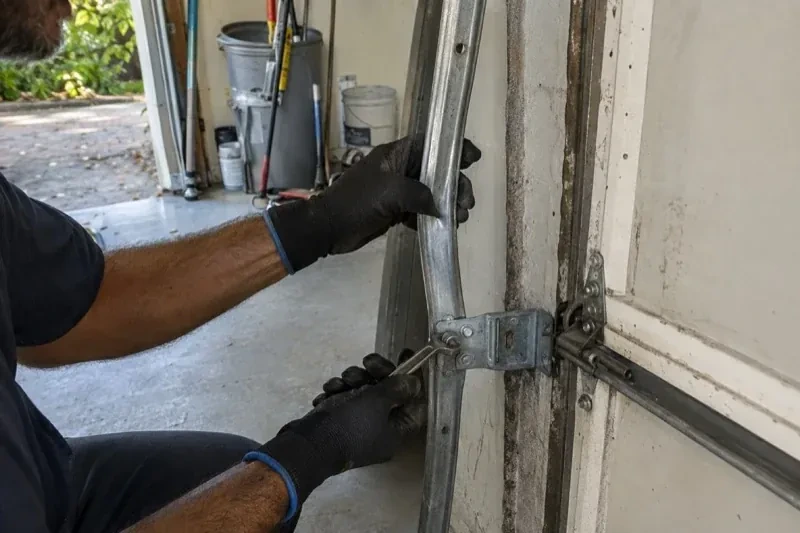
The bottom foot of a garage door track has a hard life in this climate. Slush and salt drip off the car and pool exactly where the bottom rollers sit, the jamb brackets and channel rust and thin, and a ridge of ice at the threshold can stop the door short while the opener keeps pulling. Winter track repair often means replacing the lowest section of vertical track and its brackets, sistering a jamb that has gone soft at the floor, and refixing everything into sound wood. A clear threshold and a look at the brackets each spring keep the new steel in good shape.
How the visit goesYou bought the house with a door that sticks near the top of its travel. The vertical track was screwed tight against the jamb, so the door drags along its stop moulding on every trip instead of swinging clear.
Toronto
How the visit goes
Plumb, spacing and taper of each vertical run
A level goes on each vertical track, and a tape measures the gap between the track and the edge of the door at the top and the bottom. The run should be plumb, and the two sides should sit the same distance from the door so both columns of rollers carry evenly. There is also a deliberate detail: the top of the vertical track stands a little further from the jamb than the bottom, so the closed door presses into its stop moulding for a seal and swings clear the moment it starts to rise. A track pushed flat to the jamb makes the door drag; one standing too far out lets it rattle.
Tension back, balance and opener tests
Once the track is fixed and every roller is seated, the springs are wound back to the turns the door calls for and the clamps come off. The technician lifts the door by hand through its full travel, watching each roller through the curve and along the horizontal run for any catch, and checks that the door holds itself at roughly waist height. It is run up and down several times by hand before the opener is reconnected, and the opener's travel limits and force settings are then adjusted to the newly aligned door, with the reversing test done against a block on the floor. You watch the finished door make the trip before the tools are packed.
Protecting the bottom of the track from salt and slush
The lowest foot of vertical track and the bracket beside it are where winter does its damage, so a little attention there pays off. Push slush away from the inside edge of the door rather than letting it pool against the track, and when a mild day comes, rinse or wipe the road salt off the bottom brackets and the channel. A dab of silicone spray on the jamb bracket fasteners in late autumn helps them shed meltwater. Keep the threshold clear of packed ice so the door meets the floor, not a ridge, and the opener never pulls against a stuck door. Those habits are what keep replacement track from meeting the fate of the last set.
Garage Door Track Repair or Replacement
In the van
- Perforated angle back hangs
- Jamb brackets or continuous angle
- Level, plumb line and square
- Lag screws and track bolts
- Flag brackets
What affects the quote
Same fees day, night or weekend
1Opener adjustment afterwards
A door running on a freshly aligned track often needs the opener's travel limits and force reset and its reversing tested. That short adjustment is named when it is needed.
2Door size and weight
A tall or double door has longer runs of track and heavier loads on the brackets, and a heavy insulated or wood door may call for heavier-gauge track and more substantial hangers.
3Bracket-mounted or continuous angle
Track on jamb brackets is adjusted bracket by bracket, while a full-height angle comes off and goes back as one piece. Each mounting style shapes the time and the fasteners quoted.
Garage Door Track Repair or Replacement: questions
Should the track be lubricated?
It depends on the door, and manufacturers disagree, which surprises many people. Some want the track kept clean and dry, since lubricant there can collect grit and let the wheels skid instead of roll, wearing the roller and the track edge; others specify lubricant at the track bend. The moving parts, roller bearings, hinge pins and springs, get their own lubricant either way, in the type the manual specifies, with a few cycles of the door to spread it.
Why does the door catch at the same spot every trip?
A catch that repeats in one place is the signature of a local track fault: a dent, a spread section, a step at a joint, or a bracket that has let the track drift. Each roller reaches the flaw at the same point in the travel and bumps over it. The technician finds the spot by running a roller through the channel by hand, then dresses or replaces that length and checks the rest of the run for the same problem.
Can a bent garage door track be straightened, or does it need replacing?
Both happen, and the damage decides. A shallow dent in the vertical run away from the curve is usually dressed back to shape with track pliers or a block, and a channel that has spread can be squeezed closed. A kink, a crack, a bend in the curved piece or steel thinned by rust is replaced with a matching section, because a hard spot in the roller path keeps catching however carefully it is worked.
Springs & Hardware
Garage Door Track Repair or Replacement near you
Every garage door service we offer in Toronto is described the same way: what you might have noticed, what the technician checks first, how the work is done and what you have afterwards. Start with the symptom you are seeing and the right service will be easy to find.