Springs · Toronto
Torsion Spring Replacement
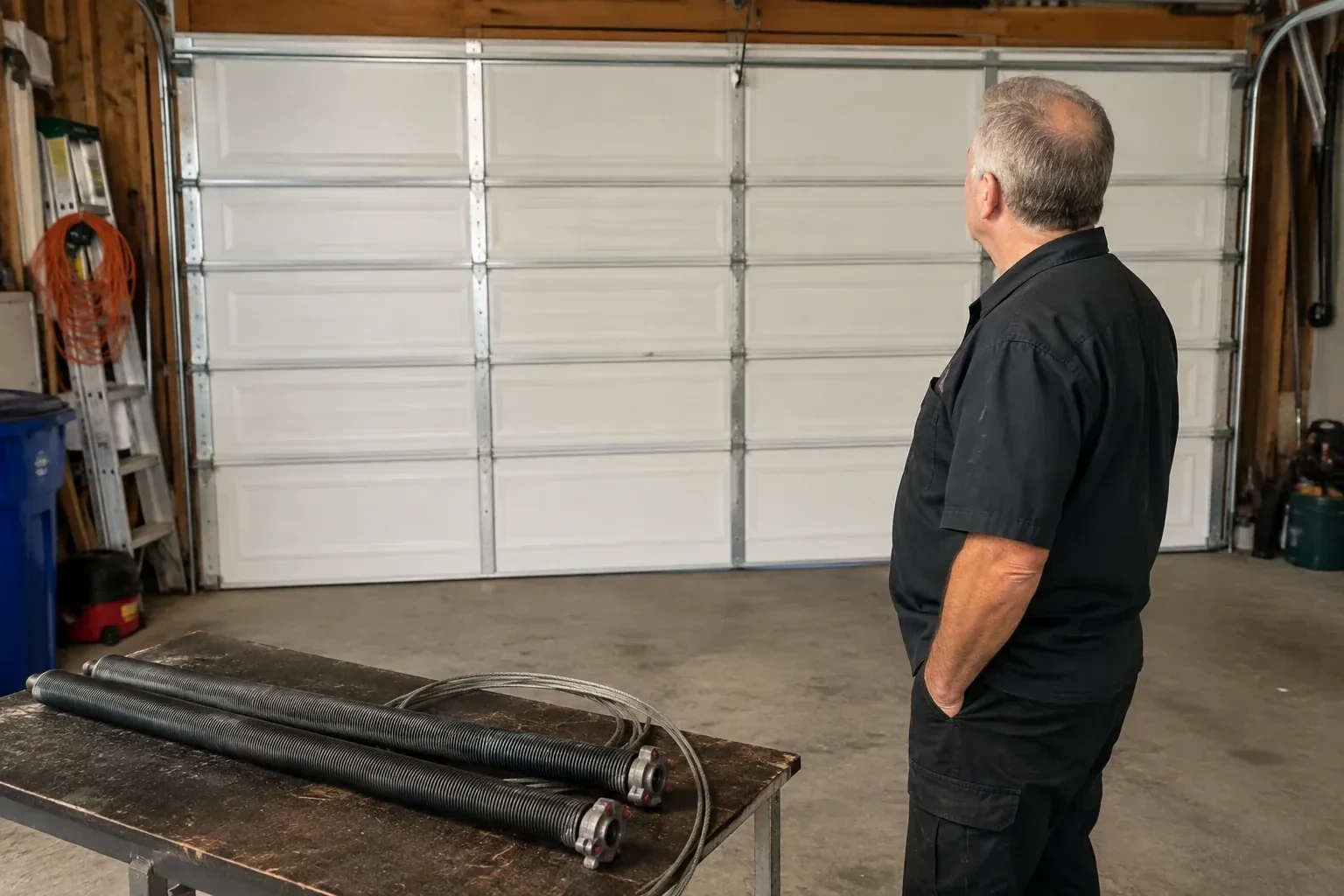
Looking up at the coil above the door, you can see a clean split with a gap of several centimetres between the two halves. The rest of the spring looks fine, but the door has become almost impossible to move by hand.
Torsion Spring Replacement
In plain words
Every spring is built for a number of open-close cycles, and replacement is a natural moment to choose that number deliberately. A standard residential spring is commonly rated around ten thousand cycles; a family that opens the door six times a day uses those up in a few years. Higher-cycle springs use heavier wire and a longer coil to produce the same force with less stress on the steel, so they last proportionally longer. The technician can explain the trade-off and fit whichever option suits the household's use of the door, then wind and balance it accordingly.
How the visit goesNothing broke outright, but the door has grown heavier each winter, opens more slowly and squeals as it moves. The springs on an older door have lost tension and the coils show pitting, so the system is asking for attention before it fails.
Toronto
How the visit goes
Reading the spring itself
The first measurements come from the spring that is already on the shaft. The technician measures wire thickness across a run of ten or twenty coils, the inside diameter of the coil, the overall length of the spring when relaxed, and the wind direction, which is read from how the coils lean. On a two-spring door each spring is checked separately, because a left-wound and a right-wound spring sit on either side of the centre bracket. Any tag or colour marking is noted too. These numbers narrow down what the door was built with, and together with the door's weight they point to the correct replacement.
Setting the cables and drums
A balanced door depends on both cables pulling equally, so drum work gets careful attention. Each lift cable is wound into the grooves of its drum with the loop secured on the drum pin, and the drums are slid firmly against the end bearing plates. The technician rotates the shaft to take up slack, then sets tension so both cables are equally taut with the door fully closed; a level across the shaft confirms it is sitting true. Drum set screws are tightened to the shaft in this position. Even cable tension keeps the door square in its tracks through every part of its travel.
Through the seasons
The new spring has been set for the door as it is today, and the seasons are part of its life. Cold mornings make steel and grease a little stiffer, so the door may feel marginally slower in deep winter while still balanced; lubrication in autumn helps. Slush and road salt carried in on tires settle on the bottom brackets and cable ends, so a rinse and a light spray in spring slow corrosion where the cables anchor. Summer humidity is easier on hardware but rewards a dry, clean track. Small seasonal habits like these let the spring reach its full rated cycle count.
Torsion Spring Replacement
In the van
- End bearing plates
- Socket set and wrenches
- Centre bearing bracket and bearing
- Winding bars
- Stationary cone bolts and nuts
What affects the quote
Same fees day, night or weekend
1Door size and weight
A double-width door, a solid wood door or a thick insulated door weighs far more than a single-width steel panel, calling for heavier wire, longer coils or more springs to balance it.
2Drum type and lift configuration
Standard-lift drums are the common case. High-lift, vertical-lift or low-headroom arrangements use different drums, cable lengths and turn counts, which changes the parts and the time involved.
3Access and working space
A vehicle that stays inside, shelving under the shaft, a very high ceiling or a tight side clearance affects how the technician sets up and how long the visit runs.
Torsion Spring Replacement: questions
What other parts are often replaced with the spring?
The shaft is free during a spring change, which makes it the natural time to renew the centre bearing and end bearings if they grind or wobble. Lift cables that show fraying or rust at the bottom brackets are replaced so the new spring pulls on sound steel, and cracked or worn drums are swapped. On older doors, a corroded centre bracket or loose lag bolts may also be addressed. Each item is shown and explained before it is added.
Why do springs seem to break in cold weather?
Cold makes steel slightly less forgiving and thickens the grease on the coils, so a spring that has already used most of its cycle life is more likely to let go on a frosty morning when the door is first opened. The cold is the final straw rather than the cause; the underlying reason is fatigue from years of cycles, sometimes helped along by rust and dry coils.
What is the difference between torsion and extension springs?
Torsion springs mount on a shaft above the door and twist to store energy, lifting the door through cables and drums. Extension springs run alongside the horizontal tracks and stretch as the door closes, pulling it up through pulleys. Torsion systems tend to lift more evenly, take up less space beside the tracks and are the standard on most modern doors. Both are professional service items because of the energy they hold.
Springs & Hardware
Torsion Spring Replacement near you
Every garage door service we offer in Toronto is described the same way: what you might have noticed, what the technician checks first, how the work is done and what you have afterwards. Start with the symptom you are seeing and the right service will be easy to find.