Springs · Toronto
Garage Door Track Repair or Replacement in Toronto
Halfway up, the door lurches and one roller rides onto the lip of the channel. Near the curve the track looks wider than the rest, and the door hesitates in the same place on the way down.
Garage Door Track Repair or Replacement
In plain words
Whether a piece of track is straightened or replaced depends on where and how it is damaged. A shallow dent in the vertical run, away from the curve, can usually be dressed back to profile with track pliers and a block, and a channel that worn rollers have pried open can be squeezed closed. A kink, a crack, a bend in the curved section or steel thinned by rust calls for a new piece of the same profile and radius, because a roller path with a hard spot in it keeps catching. The technician shows you the damage and explains which option suits each piece before the work starts.
How the visit goesAfter a decade of slushy winters the bottom foot of the track is flaking rust. A roller squeals as it passes, and the channel edge has gone rough and thin where the salt collects.
Toronto
How the visit goes
What bent it
The last question is why the track moved, because the answer shapes the repair. A crease at bumper height with paint transfer is impact. A track that has crept off the jamb with screws backed out is vibration and time. Rust at the floor is winter. A twisted section on one side with a slack cable beside it usually follows a cable or spring failure that tipped the door. Overhead damage tends to trace back to storage, a ladder or a hanger that gave way. You will be asked what happened before the symptom, since a shovel in the opening or a nudge from the car is a fact only you can supply.
Replacing a vertical section
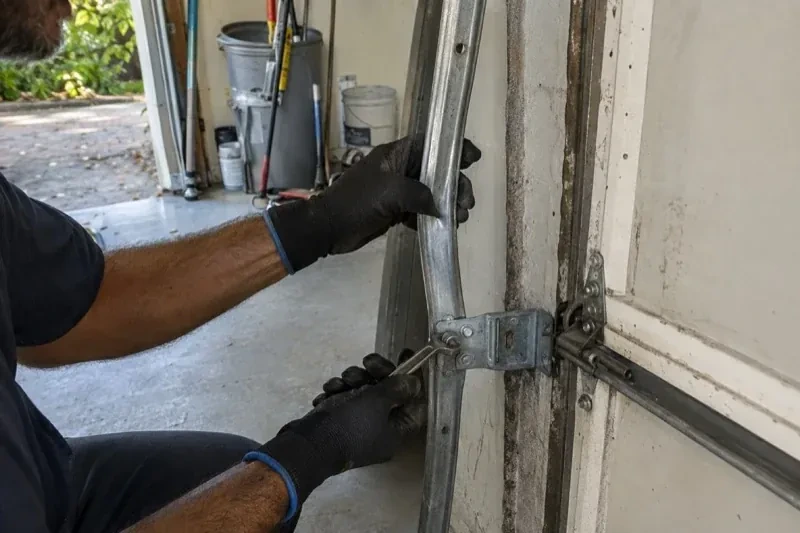
A kinked, cracked or rust-thinned vertical track comes off in one piece. The jamb brackets or continuous angle are unbolted, the old track is lifted clear with the rollers eased out of it, and the new piece, cut or ordered to the same height, profile and mounting style, is bolted to the brackets. The joint with the curve at the flag bracket is aligned so a roller passes with no step, and the track is offered up to the jamb, set plumb with the correct spacing and taper, and lag-screwed into sound wood. The rollers are threaded back in as the door is released from its clamps a little at a time.
Parking and storage habits around the track
Most creased tracks are met by a bumper or a mirror, and most bent horizontal runs by a ladder, a bike or a shelf. It is worth walking the garage after the repair and noticing what sits close to the track: move the recycling bins and the hockey bags a hand's width further in, hang nothing from the back hangs, and leave the horizontal runs clear of stacked boxes. Inside the car, a strip of tape on the floor or a tennis ball on a string marks where to stop. None of this is a chore, and it addresses the single most common reason a straightened track needs straightening again.
Garage Door Track Repair or Replacement
In the van
- Perforated angle back hangs
- Jamb brackets or continuous angle
- Level, plumb line and square
- Lag screws and track bolts
- Flag brackets
What affects the quote
Same fees day, night or weekend
1Corrosion and seized fasteners
Lag screws and track bolts rusted solid take time to free or cut, and hardware eaten by salt is replaced rather than reused, which appears in the parts list.
2Opener adjustment afterwards
A door running on a freshly aligned track often needs the opener's travel limits and force reset and its reversing tested. That short adjustment is named when it is needed.
3Track profile and radius
Two-inch track in a 12-inch or 15-inch radius is stock for most residential doors; three-inch track, unusual radii and high-lift pieces are ordered to the door and priced as such.
Garage Door Track Repair or Replacement: questions
Should the track be lubricated?
It depends on the door, and manufacturers disagree, which surprises many people. Some want the track kept clean and dry, since lubricant there can collect grit and let the wheels skid instead of roll, wearing the roller and the track edge; others specify lubricant at the track bend. The moving parts, roller bearings, hinge pins and springs, get their own lubricant either way, in the type the manual specifies, with a few cycles of the door to spread it.
Why does the door catch at the same spot every trip?
A catch that repeats in one place is the signature of a local track fault: a dent, a spread section, a step at a joint, or a bracket that has let the track drift. Each roller reaches the flaw at the same point in the travel and bumps over it. The technician finds the spot by running a roller through the channel by hand, then dresses or replaces that length and checks the rest of the run for the same problem.
Can a bent garage door track be straightened, or does it need replacing?
Both happen, and the damage decides. A shallow dent in the vertical run away from the curve is usually dressed back to shape with track pliers or a block, and a channel that has spread can be squeezed closed. A kink, a crack, a bend in the curved piece or steel thinned by rust is replaced with a matching section, because a hard spot in the roller path keeps catching however carefully it is worked.
Springs & Hardware
Garage Door Track Repair or Replacement near you
Every garage door service we offer in Toronto is described the same way: what you might have noticed, what the technician checks first, how the work is done and what you have afterwards. Start with the symptom you are seeing and the right service will be easy to find.